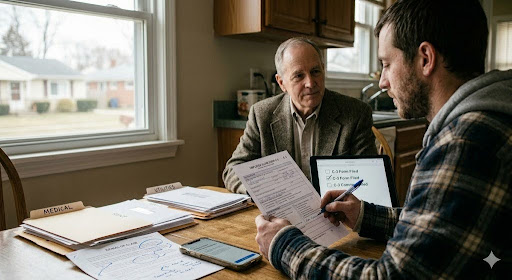
Here’s the mistake I see most often, and it costs workers everything: a supervisor walks over after an accident, looks at the situation, and says, “Let’s see how it feels tomorrow before we make it a whole thing.” The worker—already shaken, maybe in pain, definitely worried about looking weak or causing drama—nods and goes home.
By the time tomorrow becomes next week, the injury hasn’t improved. But now the employer’s insurer has a gap in the timeline. The medical records don’t start until days after the incident. The supervisor’s verbal assurance has evaporated. And the injured worker is left trying to prove that a real injury happened at a real job site, while the paperwork tells a different story.
I’ve been on the other side of that paperwork. I’ve audited claims. I know exactly what adjusters look for when they want to question whether an injury was work-related. The 72 hours after a construction accident aren’t just important—they’re often the entire ballgame.
What the First Hours Actually Look Like (And What They Should Look Like)
Most workers I talk to describe the same sequence. Something happens—a fall, a tool strike, a sudden back spasm lifting materials. There’s a moment of shock. Coworkers gather. A foreman shows up. Someone says “you okay?” and the instinct is to say yes, or at least “I think so.” Nobody wants to be the guy who shuts down the job.
What should happen instead: the injured worker gets moved away from the hazard immediately. Site safety protocols are clear that removing workers from an active hazard area and blocking it off isn’t optional—it’s the first response. That’s not about drama. It’s about preventing a second injury and creating the physical record that something went wrong at that location.
Then, before anything else, the injury gets reported to the supervisor on record. Not mentioned in passing. Reported. That distinction matters more than most workers realize until it’s too late.
The Timeline That Protects You
Don’t let anyone simplify this into “just report it when you’re ready.” Each window has a specific function in the claims process, and missing one creates a gap that adjusters will find.
| Timeframe | Action Required | Why It Matters |
|---|---|---|
| First hour | Report to supervisor using specific language about what happened and where | Vague language gives adjusters room to argue causation |
| Same day | Seek medical attention at employer-directed clinic or your own provider | Delays create gaps insurers use to question whether the injury was work-related |
| Within 24 hours | Employer must report hospitalizations, amputations, or eye injuries to OSHA | Federal law requires it; non-reporting is a violation that affects your claim |
| Within 30 days | File your own Employee Claim Form C-3 in New York | Your employer’s paperwork doesn’t cover you—this form is yours alone |
That last point trips up more workers than any other. Your employer files their own report. You file yours. Assuming one covers the other is how claims stall for months.
The Comparison That Changes Everything
Let me put two scenarios side by side, because this is where I see workers make the decision that shapes everything that follows.
Scenario A: Worker hurts his shoulder on a Tuesday. Supervisor says to ice it and come back Wednesday. Worker goes home, doesn’t see a doctor, doesn’t file anything. Thursday the pain is worse. He tells the supervisor again. Supervisor fills out an incident report—two days late. Worker goes to urgent care Friday. The insurer receives a claim where the injury date, the report date, and the first medical visit are all different days, with no explanation in writing for the gaps. The adjuster flags it. The claim gets delayed. The worker misses two weeks of pay while the investigation drags on.
Scenario B: Same injury, same Tuesday. Worker tells the supervisor immediately, uses clear language about what happened and where. Supervisor fills out the incident report that day. Worker goes to the employer-directed clinic that afternoon, gets examined, and the doctor notes the mechanism of injury in the chart. Worker files his own C-3 form within the week. Everything lines up. The claim moves forward.
The injury is identical. The outcome isn’t.
This is why I get impatient with content that dances around the practical reality: the system isn’t designed to help you. It’s designed to process claims efficiently, and “efficiently” often means finding reasons to question or reduce them. Your job in the first 72 hours is to make the timeline airtight.
Documenting What Happened—Before Memory Fades
Documentation isn’t just for lawyers. It’s for you, right now, when details are still fresh.
At the scene:
- Photograph the location before anyone cleans it up or moves equipment
- If there was a wet floor, a broken rung, unsecured scaffolding—photograph it
- Write down the names of coworkers who witnessed what happened and what they saw (don’t ask them to sign anything—just note who was present)
In writing, for yourself:
- Write your own account of the incident in plain language: what you were doing, what went wrong, what you felt immediately after
- Date it and keep it somewhere your employer doesn’t control
- Email it to yourself if you have to
With medical providers:
Be precise. Tell them exactly how the injury happened at work. “I hurt my back” is not the same as “I hurt my back lifting a 200-pound beam on a construction site when the load shifted.” The second version creates a medical record that supports your workers’ compensation claim. The first one leaves room for doubt.
One more thing. If your employer has you sign anything in those first hours—an incident report, a statement, anything—read it carefully before signing. You have the right to review what you’re signing. If something is inaccurate, say so. If you’re pressured to sign something that doesn’t match what happened, write that down too.
When Three Separate Systems Split Into Different Paths
Most injured construction workers think there’s one system handling everything. There isn’t.
Workers’ Compensation is the primary system for most job-site injuries. It covers medical treatment and a portion of lost wages regardless of fault. Your employer’s insurer handles this—which means their interests and yours are not the same. The insurer’s job is to manage costs. Your job is to document everything that supports your claim.
OSHA is separate. Filing an OSHA complaint doesn’t start a compensation claim and doesn’t get you paid. But it creates an official record of hazardous conditions. If you were injured because of a safety violation—unsecured scaffolding, missing fall protection, equipment that wasn’t maintained—an OSHA investigation can establish facts that support a broader legal claim.
Third-party claims are the piece most workers miss entirely. If your injury involved equipment manufactured by a third party, a subcontractor’s negligence, or a property owner’s failure to maintain safe conditions, you may have a personal injury claim outside of workers’ compensation. Workers’ comp limits what you can recover. A third-party claim doesn’t have those same caps. This is why consulting construction accident attorneys in boston matters—not because you’re necessarily suing anyone, but because you need to know which paths are open before they close.
The 30-day mark is a practical checkpoint. By then, you should know whether your workers’ comp claim is moving forward, whether OSHA involvement is relevant, and whether a personal injury attorney has reviewed the facts. After 30 days, some options narrow. Statutes of limitations exist. Evidence disappears. Witnesses move on.
The Objections I Hear Every Time
“I don’t want to make trouble.”
Consider what “not making trouble” actually costs: delayed treatment, unpaid bills, a claim that gets questioned because you waited. The workers I talk to who stayed quiet to avoid conflict are the ones calling me six weeks later in a panic.
“My supervisor said it’s handled.”
Verbal promises don’t appear in claim files. What’s handled in conversation means nothing when the insurer reviews paperwork. If it’s not in writing, it doesn’t exist in the claims process. Get everything confirmed in writing—the incident report number, the name of the medical provider you’re authorized to see, the claim number once it’s assigned.
“I’m worried about retaliation.”
This is real, and I won’t pretend it isn’t. Retaliation for filing a workers’ compensation claim is illegal, but that doesn’t mean it never happens. What protects you is documentation: the date you reported, what you said, who was present. If your hours get cut or your assignment changes after you file, write it down with dates. That pattern becomes evidence.
What “Getting It Right” Actually Requires
Here’s the short version, stripped of everything else:
- Report immediately. Use specific language. Say “injury,” not “I tweaked something.”
- Get examined the same day. The medical record anchors your claim to the date of injury.
- Photograph the scene before anyone moves anything.
- Write your own account and store it somewhere you control.
- File your own claim form. Don’t assume your employer’s report covers you.
- Get everything in writing. Verbal assurances are worth nothing in a claims file.
- Know that three separate systems exist—and that a third-party claim may be available even if workers’ comp is already moving.
Workers who come out of this with their treatment covered and their income protected aren’t the ones who got lucky. They moved fast, documented everything, and didn’t take verbal assurances as substitutes for written records.
Your Next Step, Right Now
If you’re reading this after an injury, start with what you can still do. Report to your supervisor today if you haven’t. Get to a medical provider today. Write down what happened while the details are clear.
If you’re past the first 72 hours and worried you’ve already made mistakes—you haven’t necessarily lost everything. But you need a clear-eyed assessment of where the gaps are and how to address them. Talk to someone who knows how claims actually work. A workers’ compensation attorney or intake consultant who handles construction injuries in your area can tell you in one conversation what you’re dealing with and what options remain open.
The window is shorter than most people realize. Don’t wait to find out how short.